Supported by


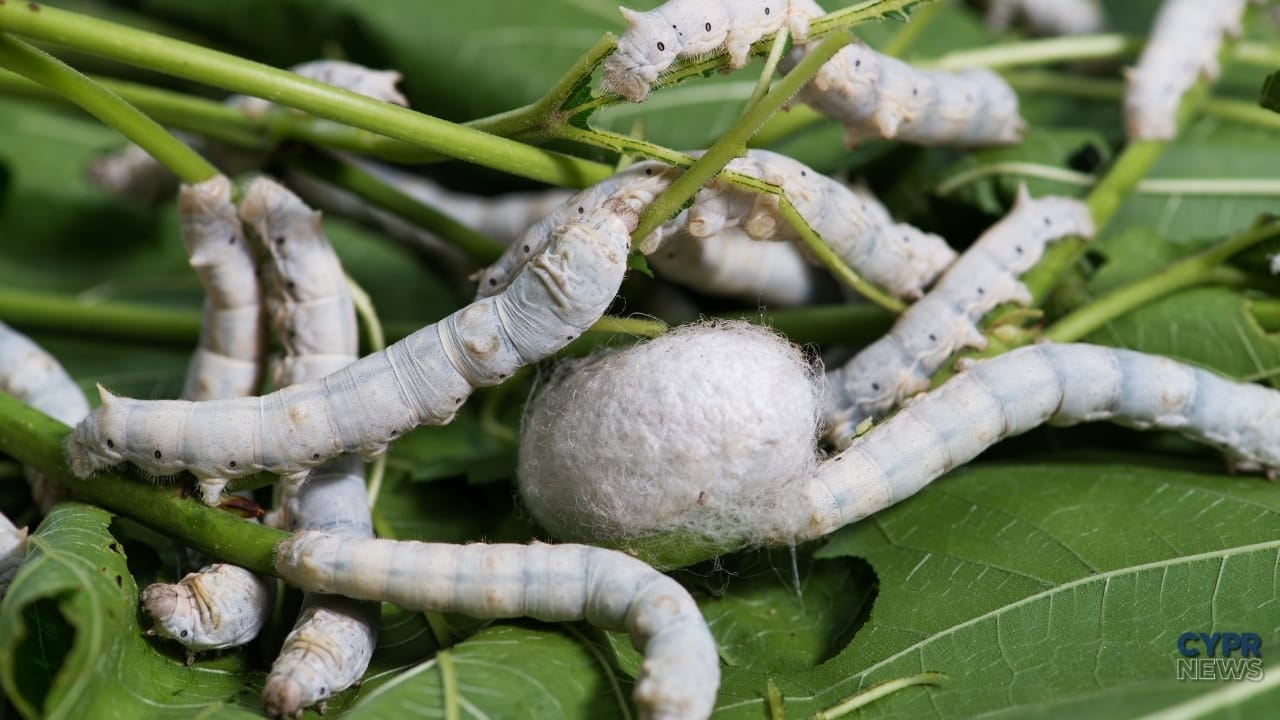
Silk in Cyprus Today, it is mainly associated with museums, old costumes, and traditional fabrics. For centuries, however, its production was an important part of the local economy, and in some villages, silkworm breeding took place in almost every home.
The tradition was particularly strong in Karpasia, but silk was also produced in Lapithos, Karavas, Mesaoria, Paphos, Kakopetria, and Fyti. Each spring, farms would begin to live in the rhythm of silkworm hatching, the harvesting of mulberry leaves, the formation of cocoons, and the subsequent spinning of incredibly fine threads.
Silk production developed on the island already in the Byzantine period.
However, it achieved particularly significant economic importance during Frankish rule. Medieval Cyprus became a major center for the production of silk and gold-embroidered fabrics, which also reached Western European markets.
Silk was therefore not just a local curiosity or a material produced solely for the needs of local residents.
It was a luxury item.
Its cultivation, spinning, weaving, and sale provided employment for entire communities. The process combined agriculture, livelihoods, crafts, and international trade.
Without mulberry, there would be no local silk.
Silkworms feed on its leaves, which is why huge quantities of these trees were planted in regions specializing in their breeding.
The Cyprus Food Museum lists Lapithos, Kythrea, Varosi, Akanthou, Karpasia, Marathasa, Solea, Morphou, Episkopi in the Limassol district and the coastal plain of Paphos as former areas of intensive mulberry cultivation.
Mulberries also grew in private backyards in various parts of the island.
Interestingly, trees growing at higher altitudes were particularly prized. Their leaves were believed to yield higher-quality silk.
This is an example of a landscape shaped by ancient crafts. Mulberries were planted not only for their sweet fruit. Their leaves, a staple food for silkworms, may have been of much greater value.
In Agios Andronikos on the Karpasia peninsula, currently located in the northern, occupied part of the island, silk production was for years one of the main occupations of the inhabitants.
The Cyprus National Commission for UNESCO describes the situation very graphically: every home, regardless of the family's economic status, became a small workshop for silkworm breeding and textile production.
Breeding began in early spring.
In the rooms, surfaces were prepared on which the silkworms were spread. This required vast quantities of fresh mulberry leaves, a suitable temperature, and regular care.
For several weeks, the tiny caterpillars practically ate and grew continuously.
Only later did they begin to create cocoons.
This is one of the most unusual customs associated with Cypriot silk production.
The traditional breeding season began in March. March 25, the Feast of the Annunciation, women placed silkworm eggs in a small bag worn at their chest.
Then they went with him to church.
It was believed that the eggs would be blessed in this way and that subsequent breeding would be successful and would yield a lot of good quality silk.
The custom also had a very practical effect. Human body heat helped maintain the temperature necessary for the development of the larvae within the eggs.
Religious ritual, traditional beliefs and practical breeding knowledge came together in one gesture.
The young larvae needed fresh mulberry leaves.
As the silkworms grew, their food requirements also increased. Towards the end of their breeding period, they needed to be fed significantly more leaves than at the beginning.
Silk production required the involvement of the entire family.
Someone was collecting leaves.
Someone was preparing them for the larvae.
Someone cleaned the breeding grounds and ensured proper conditions.
Silkworms couldn't be left unattended for several days. The entire household had to adapt its daily rhythm to the next stages of their development.
When the larvae reached the appropriate size, they stopped eating and began building cocoons.
The silkworm creates a cocoon from a very long, continuous fiber.
The larva secretes a liquid proteinaceous substance that hardens upon contact with air. It then gradually envelops its own body with it by successive head movements.
A white, creamy or slightly yellowish cocoon is formed.
Once properly prepared, the fiber can be unwound. However, the thread from a single cocoon is very thin, so fibers from several cocoons are combined to create a stronger yarn.
In Agios Andronikos there were specialists called metaxadeswho were engaged in obtaining threads. Their skills were valued beyond the town as well, so they served residents of neighboring villages.
The work required experience and caution. The delicate fiber was easily torn, and locating its origin on the cocoon's surface was one of the most crucial moments of the entire process.
In many regions, women were responsible for almost the entire production cycle.
They cared for silkworms, prepared the fibers, spun the threads, and then wove the finished fabrics.
In Agios Andronikos, silkmaking and weaving were distinctly female pursuits, with knowledge passed primarily from mother to daughter.
There was no school where one could learn all the stages of breeding.
The girls watched the older women.
Later they helped with simpler tasks.
Over time, they learned to care for silkworms, unwind cocoons, and operate looms on their own.
Thanks to this, knowledge could survive for generations to come.
One of the important centers of production was Kythrea.
Historical accounts from the 19th century indicate that silk was one of the most important sectors of the local economy. The development of silk farming was facilitated by the large number of mulberry trees growing in the presence of water from local springs.
Similar traditions existed in many other parts of the island:
Not every locality had to engage in all stages of production to the same degree. Some were dominated by silkworm breeding, others by spinning thread, and still others specialized in weaving specific types of fabrics.
Silk thus connected inhabitants of different regions into one extensive production system.
Cypriot weavers did not limit themselves to producing smooth, single-colored fabrics.
Striped and patterned fabrics were created for clothing, home furnishings, and decorative items. Silk could also be combined with cotton or other fibers, creating materials with varying properties and price points.
The finished products served local families, but could also be sold.
In the Middle Ages, luxurious silk fabrics decorated with gold threads were particularly valuable. In later periods, everyday materials also gained greater importance.
Silk production, therefore, did not refer to one specific product. It encompassed a whole range of fabrics, techniques, and applications.
Industrial textile production changed everything.
Hand-feeding the silkworms, preparing the cocoons, unwinding the fibers, and weaving the fabrics required an enormous amount of labor. Each step was performed without modern automation equipment.
Cheaper materials and industrial textile factories gradually made home breeding unprofitable.
In addition, there were social changes.
Residents left the villages and took up other professions, and younger generations were less and less willing to adopt the time-consuming skills of their parents and grandparents.
The events of 1974 were also significant. Many towns particularly closely associated with the silk industry found themselves in occupied territories, and their Greek Cypriot inhabitants were forced to leave their homes.
As a result, silk production ceased to be a normal part of farm life. Over time, it became primarily a part of the cultural heritage.
In 2022 "The art of silk, weaving and silk fabrics" were included in the National Register of Intangible Cultural Heritage of Cyprus.
It is not on the UNESCO World List of the Intangible Cultural Heritage of Humanity.
This is a national register maintained by the Cyprus National Commission for UNESCO, whose aim is to document and protect the traditions preserved on the island.
Knowledge of silkworm breeding, cocoon development and weaving is still presented through workshops, craft demonstrations and educational activities.
The Cyprus Handicraft Centre helps preserve ancient weaving techniques and pass them on to others.
Silk did not return as a major sector of the Cypriot economy, but the skills involved in its production were not entirely forgotten.
There are still many old mulberry trees on the island.
Today we pay attention primarily to their fruits.
Black, red or white.
Sweet, soft, and so intensely coloring the skin that after picking them, your hands can remain purple for a long time.
In the past, the most valuable part of the tree was not necessarily the fruit.
The most important could be leaves.
These were fed to silkworms. Their cocoons were then used to extract delicate fibers, which were woven into fabrics that were sent to Cypriot homes, workshops, and foreign markets.
That's why an old mulberry tree growing along a country road can be more than just an ordinary fruit tree.
It may be one of the last vestiges of the times when the production of luxury fabrics began not in a factory, but in a home garden.
It is difficult today to imagine a farm where, for several weeks, thousands of tiny caterpillars become the most important inhabitants.
You have to collect leaves for them every day.
Provide appropriate conditions.
Monitor subsequent stages of development.
And then patiently process the resulting cocoons.
In the past, in some regions of the island such a sight was not unusual.
Silkworm breeding involved entire families, but women held particular responsibility. They preserved the knowledge and passed it on to subsequent generations.
Thanks to their work, inconspicuous mulberry leaves were transformed into one of the most luxurious materials of the ancient world.
And that is why the history of silk in Cyprus is not just a story of beautiful fabrics.
It is the story of entire communities who, every spring, transformed their homes into small farms, workshops and family silk factories.
Sources: Cyprus National Commission for UNESCO, Cyprus Food Museum.