Supported by


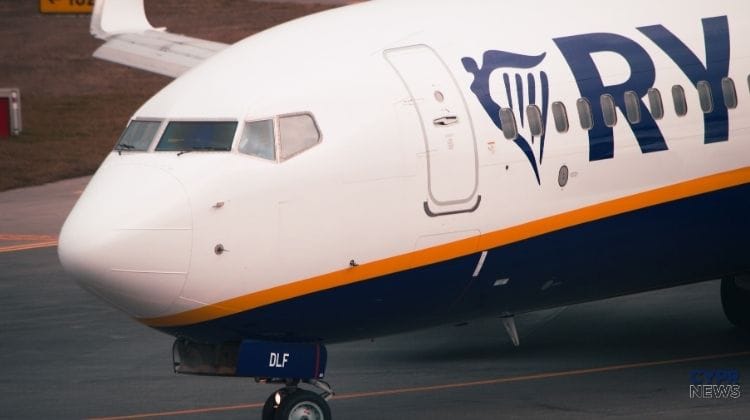
Four inspections of Ryanair aircraft conducted over the past two years have not revealed any deficiencies serious enough to justify curtailing the airline's operations in Cyprus. However, aviation authorities are continuing to investigate the serious incident that occurred on July 10, and new information about the possible cause of the crash emerged on August 13.
The Department of Civil Aviation conducted four inspections of Ryanair aircraft over the past two years. According to a response submitted to Parliament, none of the findings were serious enough to warrant immediate flight restrictions or indicate safety issues with the airline's operations. Any identified deficiencies were addressed through established corrective procedures.
The matter was brought to the attention of the MP from Limassol, Efraim Christou, after the high-profile incident on July 10, 2026. The Civil Aviation Department stated that it was aware of the case and would analyse both the results of the investigation and any safety recommendations issued at the European level.
The incident occurred on board a Boeing 737-800 with registration number 9H-QEU, operated for Ryanair by the group's subsidiary Malta Air.
The aircraft was operating flight FR1879 from Thessaloniki to Memmingen in GermanyThis is an important clarification, as some initial reports cited Munich as the flight destination. Flightradar24 data clearly points to Memmingen.
About six minutes after takeoff, during a climb at an altitude of approximately 15,000 feet (4.6 km), the right engine sustained significant damage. Fragments of the engine struck the fuselage and shattered one of the cabin windows.
A 61-year-old passenger seated next to a window was partially trapped in the crash. Other passengers managed to pull him back into the cabin. He suffered neck and shoulder injuries and abrasions. The plane descended and returned safely to Thessaloniki.
On August 13, the Associated Press reported details of new findings by the U.S. National Transportation Safety Board (NTSB), which is leading the investigation after the case was referred by the Greek Air Accident Investigation Commission.
According to investigators, one of the right engine's fan blades broke. Fragments escaped the engine housing, damaging the fuselage and shattering a window in the 11th row.
What is particularly important, inside the engine was found bird remainsThis may indicate a bird strike, but the NTSB does not currently believe this was the cause of the crash.
Technical documentation also indicates that the damaged engine's blades underwent ultrasonic inspections in November 2025 and May 2026. The inspections revealed no damage. At the same time, crews reported four suspected bird strikes of the same engine over the previous year, and bird debris was found after two such incidents.
This is one of the most important new elements of the investigation. However, it does not yet mean that the cause of the incident has been definitively determined.
Aircraft of foreign carriers can be inspected while parked at Cypriot airports under the joint European SAFA/SACA ramp inspection programme.
Inspectors can check, among other things, aircraft documentation, crew licenses, cabin and cockpit safety equipment, cargo being carried, and the apparent technical condition of the aircraft. The European Aviation Safety Agency provides a list of 53 inspection areas.
However, it is important to distinguish: Ramp inspection is not a full technical inspection of the aircraftEASA itself emphasizes that such a check is an on-site assessment and does not replace the ongoing supervision of the carrier, nor can it be considered a guarantee of the technical condition of a specific machine.
However, if inspectors find a serious deficiency affecting safety, they may require it to be corrected before the aircraft is allowed to fly again.
The aircraft involved in the July incident formally belongs to Malta Air, a Ryanair Group company. Malta Air holds an Air Operator's Certificate (AOC) issued by the Maltese Aviation Authority, which is why Malta is responsible for the ongoing oversight of the operator. Transport Malta certified Malta Air as a Ryanair Group carrier in 2019.
This doesn't mean, however, that Cyprus cannot inspect its aircraft. Aircraft belonging to carriers overseen by other European Union member states can be inspected at Cypriot airports under the SACA program. The results of such inspections are then entered into a common European database maintained by EASA.
At this stage, the Department of Civil Aviation sees no basis for imposing additional restrictions on Ryanair Group operations. However, the frequency of subsequent inspections may be revised if new information or recommendations emerge from the ongoing investigation.
The material was prepared based on information provided to Parliament by the Department of Civil Aviation, data from EASA and Transport Malta and the findings of the NTSB investigation.
Sources: Cyprus Department of Civil Aviation, EASA, Transport Malta, NTSB, Associated Press, Flightradar24, Cyprus News Agency, Philenews.