Supported by


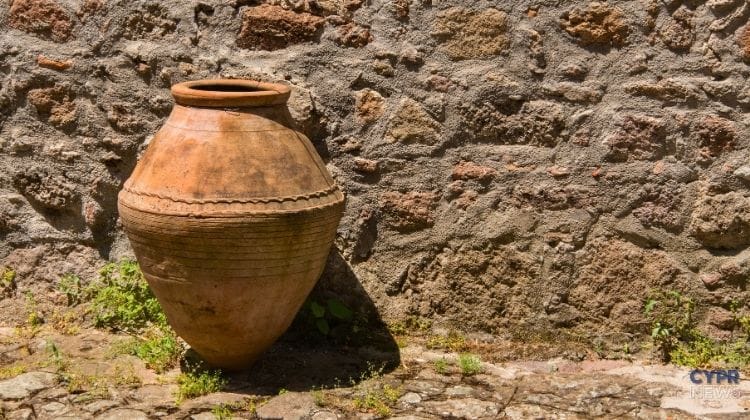
Pitharia in Cyprus They were once much more important than the decorative clay vessels that now stand in the courtyards of old houses. These large ceramic vessels held water and wine, among other things, and their creation required weeks of work by an experienced potter.
Some of the most important centers of this tradition were Phini and Kornos. In the former, men specialized in the production of large pitharia, while women primarily made smaller vessels needed for storing and carrying produce and water.
They weren't decoration. They were meant to be functional.
The Cyprus UNESCO National Commission describes traditional red pottery as part of everyday household life: vessels were used for cooking, transporting, preserving and storing food.
In Kornos, pitharia were used for storing wine and water, among other things. They were also used to prepare trachanas – a traditional product that is still used to make a distinctive soup today.
A large clay vessel was once part of the household equipment, much like a refrigerator, tank, or kitchen container today. The difference was that you couldn't simply drive to the store to buy one.
In Phini, the production of the largest vessels was mainly carried out by men called pitharades – from the word pithari.
The problem was the size of the finished vessel. Transporting such a clay giant was difficult and risky, so large pitharia were often made directly on the spot where they were to be used.
The potter would arrive in the client's village in spring or summer. Interestingly, even the clay was imported from the area around Phini. The material was transported to the work site by the client's people.
This meant that ordering a pithari was more like hiring a builder than buying a regular pot.
Such a huge pithari could not be formed at once.
First, a suitably thick base was created. Then the potter would prepare a roll of clay and add another ring to the emerging vessel. The next day, another layer was added. The process was repeated for many weeks.
The freshly crafted piece needed to be protected from drying out. In Phini, vine or walnut leaves were used for this purpose. Depending on the size, creating the entire vessel took several weeks, followed by a drying period.
It's worth knowing
On many ancient pitharia, potters left their name and the date of creation. Some also included the name of the person who commissioned the vessel.
Thanks to this, an old clay container can today be not only a monument of craftsmanship, but also a very personal trace of a specific resident and a specific household.
Simply shaping and drying the vessel was not the end of the work.
In Phini, pitharia were fired in large wood-fired kilns. Due to the size of the vessels, the firing process took about three days.
After being removed from the kiln, while the clay was still hot and its pores were open, the vessels were sealed with tar and vinegar. This was done to limit the permeability of the walls and allow the pithari to be used as a container.
For smaller vessels, the process was different. Traditional Phini pottery was made from local clay, shaped by hand or with a simple potter's wheel, and then fired in a kiln.
Phini was not the only center of production.
In Kornos, red pottery also developed as a distinctive local craft. The vessels were hand-formed on a low, slowly rotating wheel powered by foot. Their intended use determined their size and shape.
Both traditions were inscribed on the Cypriot Inventory of Intangible Cultural Heritage: Kornos pottery in 2016 and traditional Phini pottery a year later.
Today, pottery is still practiced there, although its function has changed. Modern products are more often utilitarian and decorative, whereas in the past they were essential household equipment.
One more detail demonstrates the importance of local crafts.
In 1983, the Republic of Cyprus incorporated a distinctive Phini clay vessel onto the reverse of its 10-cent Cypriot pound coin. The motif remained associated with the coin until the transition to the euro.
This is an unusual path for an object that was created primarily to solve very ordinary problems of everyday life.
Today, large pitaria can be seen in courtyards, next to old houses, and in places associated with traditional crafts. Sometimes they serve as eye-catching decorations.
In the past, however, they were something completely different.
They served as a storage facility, a reservoir, a work tool, and an object crafted by a skilled craftsman over many weeks. And a single well-preserved pithari can now tell more about ancient life on the island than many decorative artifacts.
The material was prepared on the basis of information from the Cyprus National Commission for UNESCO and materials from the Phini Community Council.