Supported by


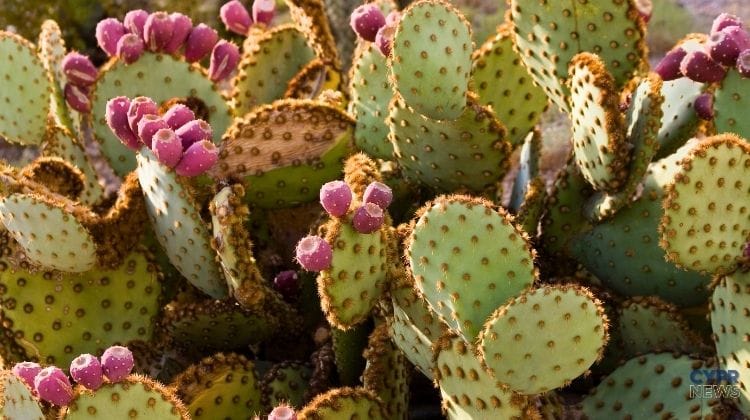
Prickly pear in Cyprus It's such a common feature of the landscape that it's easy to pass it by without much notice. In summer, the situation changes – the characteristic flat shoots bear edible fruits, although trying to pick them with your bare hand can end very unpleasantly.
For many Poles, the first association with such a fruit may be the well-known Tymbark CactusThe drink bearing this name is still included in the "Fruits of the World" line. In Cyprus, however, the exotic association with cardboard can be seen in a much more natural version – growing along fields, roads, and amidst the arid Mediterranean landscape.
Prickly pear (Opuntia ficus-indica) looks as if it has always belonged to the Mediterranean landscape. However, its history begins much further back.
The Royal Botanic Gardens, Kew, lists Mexico as the natural origin of this species. Over time, the prickly pear spread far beyond the Americas and became a characteristic feature of many arid regions of the world.
Cyprus proved to be a very suitable location. A research project conducted in cooperation with the University of Cyprus indicates that prickly pears are well-suited to dry climates and may require less water than many other crops. Researchers even explored the possibilities of wider use and export of Cypriot fruits.
It is not a native species to the island, but it has settled here exceptionally well.
In local usage, the fruits of the prickly pear are called παπουτσόσυκα – papoutsosykaThis name also appears in official Department of Agriculture documents regarding agricultural production.
The Office of the Commissioner for the Environment draws attention to a very simple, local way of eating them: Cypriots are eager to eat the fruit peeled and well chilled.
After removing the thick skin, what remains is juicy flesh with numerous small seeds. The fruit can be eaten on its own, but it is also suitable for processing.
It's worth knowing
If you hear the word in the market or in conversation with a Cypriot papoutsosyka, it's not about an exotic species of fig. These are the fruits of the prickly pear – Opuntia ficus-indica.
And here a very Polish accent appears.
The name "prickly pear" may not sound familiar to everyone, but Cactus Much more so. Tymbark still offers a drink with this name in its "Fruits of the World" series, so for some Poles, this may be their first association with cactus fruit.
The difference is that in Cyprus, we don't just see the fruit in its colorful packaging. We can see entire plants, often reaching considerable size, with flat green segments and fruit growing at their edges.
This is one of those cases when a product known from a Polish store suddenly takes on a completely different meaning while living or vacationing on an island.
The fruit may look innocent. Even large, easily visible thorns don't have to be a problem.
Prickly pears also have glochids – very fine, almost hair-like thorns. They can easily penetrate the skin and cause painful irritation. The University of Nevada Extension recommends wearing protective gloves and tongs when picking the fruit.
This is why roadside fruit should not be treated like an apple that can be picked and eaten immediately.
Before consumption, the tiny thorns must be removed and the skin peeled. In various countries, this is achieved by mechanically cleaning the fruit or by burning the surface, which removes the glochids. The FAO also describes special post-harvest preparation of prickly pears precisely because of the presence of these tiny thorns.
The easiest way is to buy fruit already prepared for eating.
The success of prickly pears in the Mediterranean landscape is no coincidence.
The plant is adapted to living in regions with limited water. An official Cypriot research project on prickly pears identified its resistance to dry conditions as one of its greatest advantages for local agriculture.
This is particularly interesting in a place where water availability is of great importance for agriculture.
So the prickly pear can do two things at once: survive where many other plants would struggle, and produce edible fruit.
For Polish readers, the prickly pear is a great example of how a stay in Cyprus can change the way we look at things previously known only from the store shelf.
First up is the Cardboard Cactus.
Then, somewhere along the road, a huge green plant appears, on which fruit ripens in the summer.
And a moment later it turns out that Cypriots have their own name for them, they eat them chilled, farmers actually grow them, and local scientists are researching the possibility of wider use of prickly pears in the economy.
There is only one thing you should still not check yourself.
Does it really sting that much?
Yes. So it's best to take our word for it and not pick it with your bare hand.
The material was prepared based on information from the Department of Agriculture of the Republic of Cyprus, the Office of the Commissioner for the Environment, the University of Cyprus, the Royal Botanic Gardens Kew, the FAO and materials from the University of Nevada Extension.