Supported by


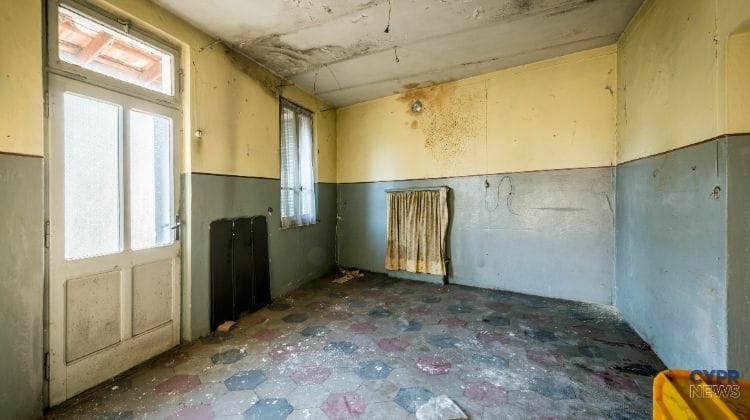
Around 30,000 uninhabited buildings in Cyprus could – according to ETEK estimates – be renovated and reused. At a time when finding affordable housing is becoming increasingly difficult, the question arises: why do existing properties remain empty instead of increasing the supply of rental housing?
Charalambos Theopemptou, former chairman of the Parliamentary Environment Committee, raised the issue again. He argued that the solution shouldn't be found solely in building more housing estates. Some answers may already exist – in empty houses, old tenements, and abandoned buildings in city centers and rural areas.
The number of approximately 30 thousand reports the Cyprus Scientific and Technical Chamber ETEK.
These are buildings that are actually uninhabited and which – at least potentially – could be repaired and put back into use, primarily as apartments.
This is an important distinction.
The official 2021 population and housing census showed 492,931 housing units, of which 354,818 were permanent residences. As many as 138,113 fell into the broad category of "vacant or temporarily used."
This does not mean, however, that there are 138,000 abandoned houses in Cyprus.
CYSTAT also includes seasonal properties and second homes, properties for sale or rent, and buildings slated for demolition in this group. Therefore, ETEK's estimate of approximately 30,000 buildings with potential for reuse is much more useful when discussing the housing market.
Theopemptou points out another problem: all such properties are often lumped together.
Meanwhile, something else is: empty premisesthat has an owner and may be in good condition, abandoned buildingwhich no one has used for a long time, dangerous building, requiring intervention for structural reasons, and historic building, the renovation of which is subject to special rules.
This distinction is important because some empty apartments could return to the market relatively quickly. Others require costly construction work, ownership clearances, or special permits.
ETEK has been pointing out for years that neglected old buildings can pose a real threat, especially when combined with inheritance problems, a lack of an owner interested in renovation, and many years of lack of maintenance.
The discussion is particularly important now, when rent prices are one of the largest expenses for many households.
In the largest cities, especially in Limassol, finding an apartment at a price corresponding to average salaries remains a major problem.
Check also:
Rent is 900 euros, with over 3,000 to start. How much does rent really cost in Cyprus?
The problem isn't just the price of new apartments. The number of existing properties that remain off the market is also significant.
The state is trying to partially utilize existing resources through the program “Renovate–Rent” – “Ανακαινίζω – Ενοικιάζω”.
Its principle is simple: the owner receives financial assistance to renovate an empty or unused premises, and in return the apartment goes on the market at an affordable rental price for eligible households.
In the current edition of the program, the maximum aid is:
The property must be at least 15 years old and located in the program area. The second round of applications began on March 16, 2026, and applications from owners will be accepted until December 31, 2027.
In return, the landlord agrees to provide the premises under an affordable rental agreement for four years. The original terms stipulated that rent be set below the average market value for the location.
This shows that the very idea of bringing empty apartments back into use already exists in CyprusThe question is rather about its scale.
Theopemptou looked at solutions used in other European Union countries.
The most direct model operates in Ireland.
Under the Vacant Property Refurbishment Grant, an owner can receive up to 50,000 euros to bring an empty property back into use. If the building is in a state of disrepair, additional assistance can increase the total amount to 70,000 euros.
The program covers both properties intended for owner-occupancy and premises that are later to be rented out.
This is almost twice the maximum basic subsidy currently offered under the Cypriot scheme for a three-bedroom apartment.
France also uses the second approach.
Instead of solely encouraging owners with subsidies, in places where there is a particularly large housing shortage, fee for long-term empty properties.
In certain areas, the owner of an unfurnished apartment that remains empty for at least a year may be subject to a special tax. Outside these areas, municipalities may, under certain conditions, introduce their own taxation of empty units.
The logic is simple: if there is a shortage of apartments in the city, keeping the premises unused for many years is no longer completely financially neutral.
A similar tool exists in Spain.
Local governments may charge an additional fee as part of their property tax for certain residential premises that remain vacant for a long time.
The basic surcharge can reach 50%, and in the case of a longer period of vacancy, even 100%, and in certain cases, a further increase is possible. However, the regulations contain conditions and exceptions – not every temporarily empty house is automatically subject to additional taxation.
Portugal takes yet a different approach.
It works there Fundo Nacional de Reabilitação do Edificado, or the National Building Rehabilitation Fund. Its goal is to renovate properties and return them to the rental market, among other things, with a particular emphasis on the revitalization of city centers. The fund continues to operate and also appears in the Portuguese budget for 2026.
It is therefore not a single subsidy for the owner, but a tool enabling the implementation of larger building renovation projects.
According to Theopemptou, the first step in Cyprus doesn't have to be another expensive program.
It is proposed to create by municipalities and local communities register of empty, abandoned and dangerous buildings.
Such a register should show not only the number of objects, but also their condition and potential.
It would be possible to define:
This would allow action to be taken as needed, rather than only reacting when a crumbling building begins to cause a problem for neighbors.
Another proposal is to simplify procedures for smaller and medium-sized renovations.
In many cases, a building does not require complete demolition and reconstruction.
Structural assessment, removal of hazardous materials, repair of essential installations, improvement of energy efficiency, access adjustments and reconnection of utilities may be required.
Such projects could have a simplified administrative path, especially if they result in the construction of an apartment that returns to the market.
This direction is also in line with European building policy.
Strategy Renovation Wave assumed at least doubling the pace of building renovation by 2030 and achieving the renovation of approximately 35 million building units throughout the Union.
For Cyprus, this potentially means more than just improving the appearance of old neighborhoods.
Renovated buildings can simultaneously increase the number of apartments, improve energy efficiency and bring life back to parts of cities and villages that are currently gradually becoming empty.
However, ETEK's estimate should not be taken as information that 30,000 ready-made premises could be launched on the market immediately.
Some buildings may have multiple heirs. Others may require costly renovations, repurposing, resolving legal issues, or requiring structural work that would make their economic reconstruction difficult.
But with the current pressure on the housing market, even a portion of that number could make a difference.
The state is already trying to repurpose empty apartments through subsidies. Theopemptou proposes going further: First, carefully calculate what can be saved, and then combine financial incentives, simpler procedures and – where justified – owner responsibilities.
Because in a country where more and more people have trouble finding affordable housing, thousands of buildings standing unused are no longer just a private or aesthetic problem.
Source: Philenews / ETEK / Ministry of Internal Affairs