Supported by


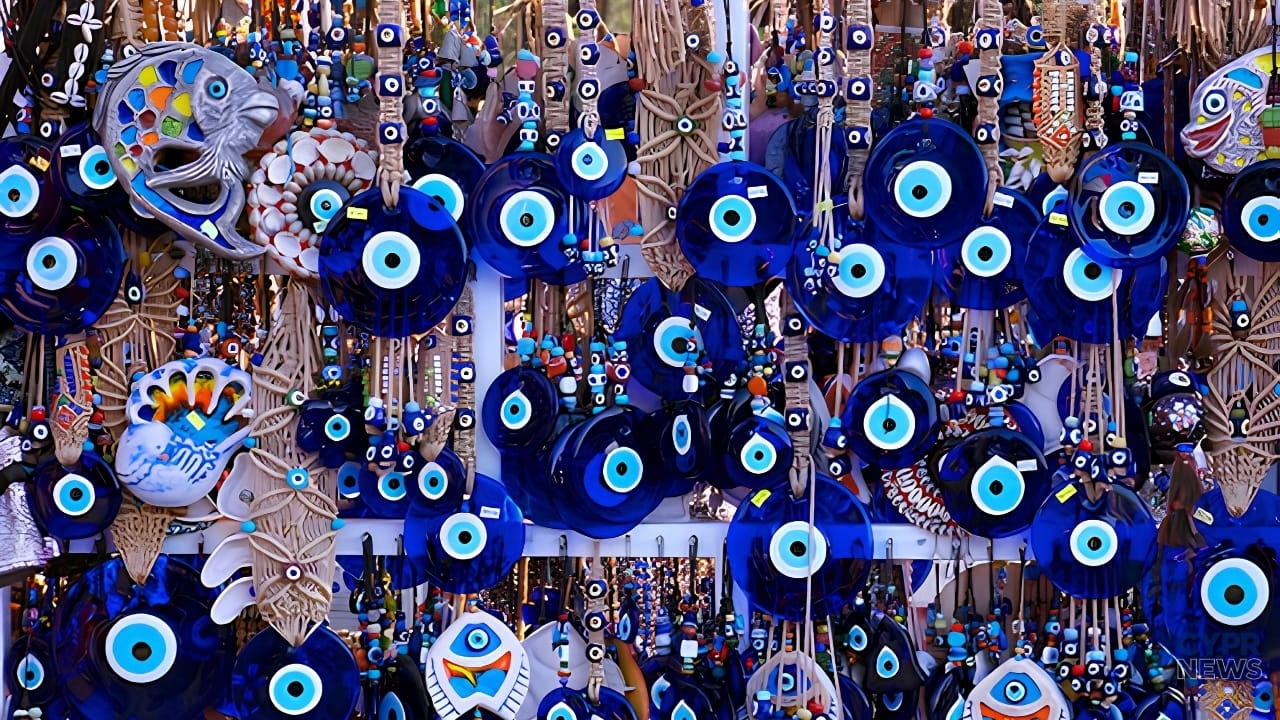
Mati in Cyprus It's much more than a popular design found on keychains and souvenirs. The blue eye can be seen in homes, cars, restaurants, on jewelry, and at the entrances to buildings. According to tradition, it's meant to protect against the "evil eye"—misfortune associated with envy, an unkind glance, or excessive admiration.
The custom is not limited to a single community or religion. Ethnographic collections from Cyprus show that blue glass amulets were used by people of various faiths, either carried on their person or hung in their homes, workplaces, or cars.
Greek word mother simply means "eye." However, in the context of folk beliefs, it refers to the belief that someone's gaze can bring bad luck, illness, or other misfortune.
In Cypriot Greek there is also the term kako mati, meaning "evil eye." In Turkish Cypriot tradition, there are similar concepts related to the harmful gaze.
It didn't always have to be about someone consciously wishing harm. In the traditional sense, even too intense admiration could be dangerous.
For this reason, people were particularly cautious in the past when praising others' children, beauty, health, or success. Compliments could be accompanied by words or gestures intended to symbolically protect the person being praised from the unintentional "evil eye."
The most recognizable form of the amulet is a glass disc with concentric circles resembling a pupil and iris. It is dominated by an intense blue, usually complemented by white, light blue, and black.
In the Greek-speaking tradition of Cyprus, similar beads were referred to, among others, as ammatopetra, while in the Turkish Cypriot tradition as göz daşı.
Many explanations for the origin of the color blue can be found online. However, some of them are presented as axiomatic without proper sources.
Ethnographic materials well document the use of blue glass beads. It is much more difficult to pinpoint a single, indisputable historical reason why this color became dominant.
Today, the blue eye is one of the most popular motifs sold to tourists. It can be found on bracelets, keychains, magnets, car charms, and wall decorations.
It's easy to dismiss them as a product created primarily for holiday shopping. However, the custom is much older than the modern souvenir industry.
Ethnographic collections document the use of such amulets in homes and workplaces. The symbol continues to function beyond tourism, appearing on cars, clothing, strollers, and everyday objects.
For some, it's a true safeguard against jealousy. For others, it remains a family tradition or simply a decorative element.
One of the most interesting examples is traditional Cypriot wedding customs.
Cyprus National Commission for UNESCO describes the ritual capnisman, or the fumigation of the bride and groom. One of its meanings was to protect the newlyweds from the evil eye.
A similar function was attributed to the red scarf or belt tied around the waists of the bride and groom. The red cloth had protective significance, and wrapping it three times around the body was associated with, among other things, warding off the evil eye.
This shows that fear of jealousy was not just a superstition held by individuals. It was part of the rituals that accompanied the most important moments in the life of the entire community.
The boundary between religion and folk customs is not always clear.
In the Orthodox tradition there is a concept Vaskania, referring to the evil influence associated with jealousy. There are also prayers recited in connection with the fear of such influence.
This doesn't mean, however, that the blue glass amulet is a religious symbol. Mati belongs primarily to the realm of folk tradition, and magical objects are not considered a substitute for prayer.
In practice, ancient beliefs and religiosity have intertwined in everyday life for generations. Thus, someone may belong to the Orthodox Church, be familiar with the belief in the "evil eye," and yet wear a small mati pendant as a family custom.
The social dimension of a custom is as important as the supernatural action attributed to it.
The "evil eye" was most often associated with envy. People feared not only overt hostility but also situations in which someone envied another person's health, beauty, wealth, children, or success.
The amulet was intended as a symbolic protection against such scrutiny. It also served as a reminder that excessive boasting about one's good fortune could attract unwanted attention from others.
Similar beliefs are found in many Mediterranean and Middle Eastern countries. In Cyprus, however, they have become intertwined with local family rituals, wedding traditions, and the daily lives of both major communities on the island.
There is no single answer.
For some people, mati is a true protective amulet. For others, it's a tradition inherited from their parents and grandparents. Still others treat the blue eye solely as a decoration or a symbol associated with Cyprus.
However, anthropological research shows that even people who no longer know ancient rituals in detail can repeat fragments of them based on family stories and habits.
This may explain why the symbol persists. Its meaning changes with each generation, but remains instantly recognizable.
A tourist sees a souvenir. A seller sees a popular product. An elderly person might see protection, and an anthropologist sees a trace of an ancient belief system.
A person wearing a small bracelet with a blue gemstone can simply say, "Just in case."
Sources: Cyprus National Commission for UNESCO, Church of Cyprus, Volkskundemuseum Wien, University of St Andrews, University of Cyprus