Supported by


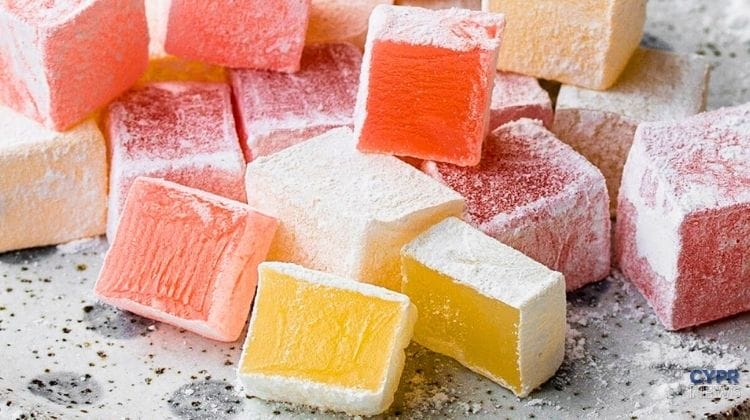
Loukoumi from Geroskipou It's much more than just a popular sweet treat. Its history began in 1895, when Sofoklis Athanasiou returned to Geroskipou after years abroad and began producing it using a recipe that was later passed down from generation to generation.
More than 130 years later, the soft cubes dusted with powdered sugar remain one of the most recognizable symbols of Geroskipou. The product also earned a place in the island's history as the first Cypriot product entered into the EU register of Protected Geographical Indications (PGI) in 2007.
According to the European Commission, the product's history began when Sofoklis Athanasiou returned to his hometown of Geroskipou with a recipe and the idea for his own business. He established a small workshop and began producing the sweets, which eventually became a characteristic feature of the village.
The tradition was then passed down through generations. Although modern production uses more modern equipment, the basic method of preparing loukoumi remains very similar to that used over a hundred years ago.
One of the distinguishing features of protected Loukoumi Geroskipou PGI is the recipe. The base is sugar, cornstarch, and water, and the flavor is added with natural flavorings or additives. Unlike many similar products, Loukoumi Geroskipou does not contain gelatin or glucose.
The mass is cooked for a long time and constantly stirred until it reaches its characteristic springy consistency. It is then poured into molds, cooled, cut into small pieces, and usually rolled in powdered sugar or coconut flakes.
The most traditional variant remains the rose-flavored loukoumi. Classic flavors also include lemon, masticha, and bergamot.
Today, the selection is much broader. You can find versions with pistachios, almonds, and other nuts, as well as more modern varieties, including chocolate. Despite the expansion of the offerings, producers still rely on traditional production methods.
For decades, loukoumi wasn't just a dessert. It was served during family visits, celebrations, and get-togethers, and over time, it became part of the local tradition of hospitality.
Its significance extended beyond Geroskipou itself. An official publication of the Republic of Cyprus recalls that the local loukoumi was already mentioned Nikos Kazantzakis in his 1926 book "Taxidevontas", and later I.M. Panagiotopoulos in the publication "I Kipros Ena Taxidi" from 1962.
The year 2007 was a turning point. Loukoumi Geroskipou became the first Cypriot product to be included in the EU register as Protected Geographical Indication.
The PGI designation protects the product's link to a specific place. In the case of Loukoumi Geroskipou, at least one stage of production, processing, or preparation must take place in the protected area.
Thanks to this, the name is not just a description of a type of sweet – it refers to a product specifically associated with Geroskipou and the local production tradition.
The history of the local delicacy also has a more spectacular chapter.
In 2004, producers from Geroskipou prepared giant loukoumi weighing over 2.5 tonsAphrodite Delights lists the event as a Guinness World Record of 2,532 kg. The Cyprus Mail's report at the time put the weight at 2,543 kg and described the process of submitting the result to Guinness World Records.
Over two and a half tons of sugar, approximately 350 kg of cornstarch, and 150 kg of dried nuts were used to prepare this record-breaking sweet. After being presented in the square in Geroskipou, the enormous loukoumi was devoured by thousands of visitors within hours.
The name of the town itself is also interesting. According to the official tourist website, it comes from the Greek words "Ieros Kipos" – "holy garden".
The place is associated with the legendary sacred gardens of Aphrodite, which further strengthens the tourist and cultural identity of Geroskipou.
To this day, producers in Geroskipou continue the local tradition, and loukoumi remains one of the products particularly associated with the Paphos region. The official tourism portal lists Geroskipou as one of the places where these sweets are still made using traditional methods and without preservatives.
It is this combination of a simple recipe, family tradition, over a century of history and a strong connection with one place that has made this small cube of sweetness a part of the island's culinary heritage.
Source: European Commission / Visit Cyprus / Press and Information Office of the Republic of Cyprus