Supported by


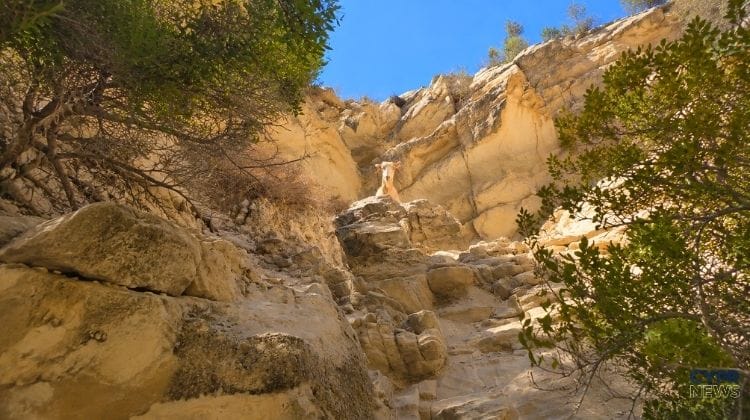
Goats in Cyprus can appear in places that appear almost inaccessible from a human perspective. However, steep slopes and rocky ledges are not unusual for them – the structure of their hooves and the way they move help them maintain stability even on very uneven terrain.
In a photo provided to the editorial team, a pale goat peeks out from behind a rock, seemingly perched above the cliff. In reality, the animal is perched on a ledge, and its seemingly precarious position clearly demonstrates the goats' abilities to navigate mountainous and rocky landscapes.
The secret begins with the hooves. They are divided into two halves that can move relative to each other to some extent and adapt to uneven surfaces. The undersides have softer, more flexible surfaces that increase friction, while the harder parts of the hoof help them grip small rocky outcrops.
Studies of the biomechanics of locomotion also show that when moving on slopes, goats adapt their limbs and joints to the slope. Therefore, they don't walk on a steep slope in exactly the same way as they do on a flat surface—their locomotion changes with the conditions.
Added to this is their relatively light build, good balance, and natural agility. This means that a rocky ledge that might seem far too narrow to a human might not be anything special to a goat.
The presence of goats on the island is not just a feature of the modern landscape. Its history dates back to the Neolithic period.
Archaeological research at the Shillourokambos site indicates the presence of goats as early as around 8500–8000 BC. This was a period when some of the earliest agricultural and herding communities developed in Cyprus.
This is particularly significant because Cyprus is an island. Research into the origins of livestock farming indicates that it was among the first places outside the natural range of livestock ancestors to which humans transported sheep and goats.
This means that the relationship between humans and goats in Cyprus has been going on for over ten thousand years.
Modern breeding encompasses various breeds and their crossbreeds. Official European documentation on Halloumi includes the local Machaira and Pissouri goats, as well as the Cypriot Damascus goat.
The history of the latter is particularly interesting. The Damask goat was introduced to the island in the 1930s. However, a long-term breeding program resulted in the local population acquiring characteristics that distinguish it from its original source. In its Halloumi documentation, the European Commission cites the development of the Cypriot type of this breed.
This doesn't mean, of course, that every goat encountered during the trip can be easily assigned to a specific breed. The animal in our photo shouldn't be identified solely based on appearance.
It's worth knowing
Goats have been present in Cyprus for over 10,000 years, but the Damascus goat was only introduced to the island in the 20th century. Today's breeding combines a very old tradition with much more recent animal selection programs.
Goats are not just a pleasant element of the landscape or an attraction encountered during mountain trips.
In the 2023 survey on the structure of agricultural and livestock farms, the Statistical Service of Cyprus noted 227,307 goatsThere were 2.4% fewer of them than in the previous survey in 2020.
Their importance is also evident in the activities of the Department of Agriculture, which monitors the livestock population and deals with issues related to sheep and goat breeding, nutrition and dairy production.
It's hard to talk about the importance of goats to the local economy and traditions without mentioning Halloumi.
The current EU PDO specification allows for the use of fresh sheep's or goat's milk, a mixture of the two, and—under certain conditions—cow's milk. The document also emphasizes the link between sheep's and goat's milk and the livestock farming practiced on the island.
It's here that it's clear that goats in Cyprus aren't just a remnant of an ancient way of life. From Neolithic settlements to the modern production of one of the island's most recognizable products, they remain a part of the local history and economy.
A photo of a goat peering serenely from behind a rock might, above all, bring a smile. But when you look closer, a single image reveals a story spanning thousands of years.
Goats have hoof structures that facilitate movement over uneven terrain, they can adapt their gait to the slope of the ground, and humans brought their ancestors to the island as early as the Neolithic period.
That's why a goat sitting high on a Cypriot rock doesn't have to think about how to get down.
The person at the bottom is probably thinking about it much more.
The material was compiled on the basis of data from the Statistical Service of Cyprus, documentation from the European Commission on Halloumi, materials from the Department of Agriculture and scientific publications on the archaeology of Shillourokambos and the biomechanics of goat movement.