Supported by


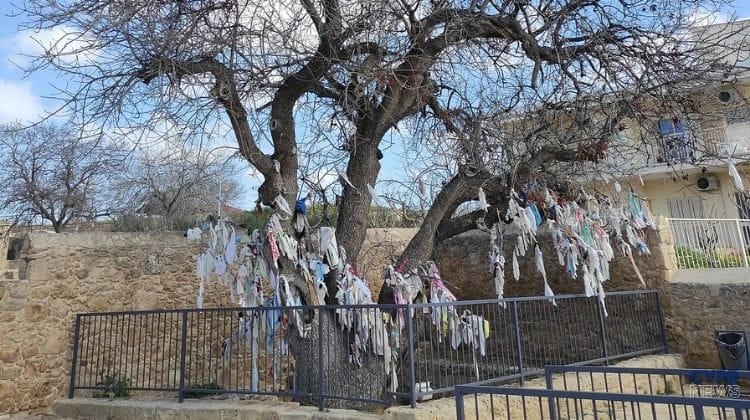
Wishing Tree in Paphos It's easy to recognize from a distance. Its branches are covered with pieces of cloth, handkerchiefs, and scraps of clothing left by people as votive offerings. It grows just above the catacombs of Agia Solomoni in Kato Paphos and has long been part of local tradition.
To the casual tourist, it might look like an extraordinary art installation. In reality, each scrap of fabric has symbolic meaning. According to tradition, they are left by people asking the saint for help, primarily for health and healing.
It is this place that makes this story even more interesting.
Beneath the tree lies a small complex of chambers carved into the rock. Archaeologists date their origins to the Hellenistic period. In later centuries, the site began to function as a Christian sanctuary and became a popular medieval pilgrimage site.
The complex consists of an open courtyard surrounded by five rock-cut chambers. One of these houses a spring, while the western chamber contains the remains of 12th-century Christian paintings.
Much younger traces of past visitors can also be found on the walls.
The plaster contains names left by the Crusaders in the 13th century.
The official Visit Cyprus website describes the tree as sacred and notes that believers leave colorful scraps of cloth and pieces of clothing on its branches as offerings to Agia Solomoni. The tree is believed to have healing powers.
A similar tradition is described on the official Paphos region tourism website. According to the site, people leave handkerchiefs and pieces of clothing on the branches in the hope of improving their health. This custom is still practiced today.
So it is not originally about a "wish" in the sense known, for example, from throwing a coin into a fountain.
It's rather vote – a material sign of request, prayer or hope.
Only over time, in tourist parlance, the place began to be referred to as a "wishing tree".
It's worth knowing
Not all contemporary sources describe the species of tree growing above Agia Solomoni identically. Wikimedia Commons classifies it as a terebinth, while the regional website Visit Paphos calls it an ancient aspen. Therefore, it's safest to simply refer to it as the sacred tree of Agia Solomoni.
Agia Solomoni is not a modern attraction created for tourists.
In the Middle Ages, the complex was a famous pilgrimage site. It also had names associated with the Seven Sleepers or the Seven Maccabees.
This shows that the unique significance of the site existed long before the emergence of modern hotels, promenades and tourism in Paphos.
Over the following centuries, the form of visits changed, but the need to leave a mark of one's presence survived.
Ancient pilgrims left names on the walls.
Modern people leave fragments of fabric on the tree.
There are several local legends associated with the place.
According to one tradition, Solomoni hid in a cave to escape persecution. The entrance was sealed, but when it was reopened many years later, the saint emerged alive. The official Visit Cyprus website presents this story clearly as a local tradition, not a documented historical event.
This is an important distinction.
The history of the catacombs and their Hellenistic origins belong to archaeology.
Stories about the saint belong to religious tradition and local legend.
However, both layers meet at exactly the same place.
People passing by on the street may first notice colorful pieces of fabric moving in the wind.
However, it is worth going a few steps lower.
Beneath the ground lies a complex spanning several eras. First, it housed Hellenistic burial chambers, then a place of Christian worship, medieval pilgrimages, and paintings. Today, it continues to be visited by residents and visitors.
The Cyprus University of Technology digital archive describes the sacred tree as part of a place where leaving a personal votive offering is traditionally associated with hope for healing.
It would be hard to find a better example of how one small part of a city can simultaneously preserve archaeology, religion, and living custom.
Colorful materials on branches may look attractive in a photo, but it is worth remembering that for some people they have religious significance.
These are not decorations hung by the city.
These are personal votive offerings left by people.
Therefore, the place should be treated with the same respect as a small chapel or sanctuary.
You don't have to believe in the healing power of a tree to see the value of a tradition that still lives on.
Paphos is primarily associated with mosaics, the Tombs of the Kings, the port and the castle.
However, a few hundred meters from the main tourist routes there is a much more inconspicuous place.
Tree.
Beneath it are ancient chambers.
Traces of medieval pilgrims on the walls.
And on the branches there are hundreds of small marks left by modern humans.
This is why the wishing tree at Agia Solomoni is more than just a photographic curiosity.
It is a place where subsequent generations continue to leave their hopes.
The material was prepared based on information from the Deputy Ministry of Tourism – Visit Cyprus, Pafos Regional Board of Tourism and Cyprus University of Technology.