Supported by


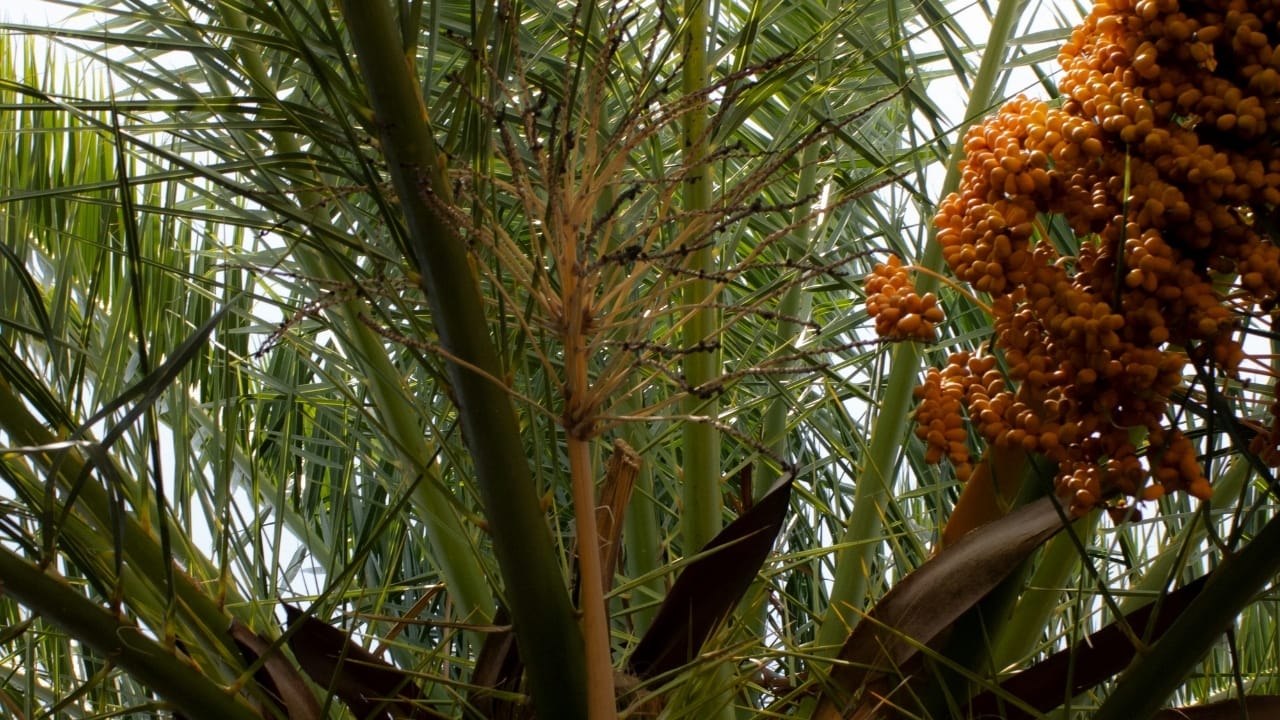
Cypriot dates can be seen both on palm trees and on store shelves. In our video, we show the fruit still on the tree, freshly picked and ready for sale. The most interesting thing, however, happens between these stages – some of the fresh dates are frozen for a few days after harvest.
And this isn't just a random Cypriot custom. Freezing can serve two purposes: it helps preserve the fruit and reduces the risk of insect infestation, but in the case of hard dates harvested at the right stage, it has an even more interesting effect. After thawing, the fruit can soften significantly within a few hours, becoming juicier and less tart. This mechanism is well described in the date storage technology.
A fresh date looks completely different from the dark, wrinkled fruit that we most often buy in packages in Poland.
Initially, it is firm, smooth, and—depending on the variety—yellow or red. Only in subsequent stages of ripening does it soften, darken, and acquire its characteristic, very sweet consistency.
In our video you can see the whole Cypriot scene: bunches on the palm tree, picked fruit and dates already available for sale.
That's what's most interesting.
Dates go through several stages of ripening. In the phase known as Khalal The fruit is now full-sized and yellow or red in color, but remains relatively firm. It contains more soluble tannins, so it can be noticeably tart. Then comes the stage Rutab – the fruit softens, darkens, becomes sweeter and less tart. Final phase Tamar is the well-known soft or dried date.
The freezer can change this process dramatically.
FAO describes that when dates harvested in the Khalal phase are frozen and then thawed, within a few hours they begin to soften and become juicyThe most likely explanation is the formation of ice crystals, which damage the fruit's cell walls. After thawing, enzymes and other components can move much more easily, allowing ripening-like changes to occur more quickly.
Studies of dates after thawing also observed a color change from yellow to golden brown, a sweeter taste, and a much softer texture.
So, briefly: hard, freshly picked date → freezer → thaw → much softer fruit.
Freezing can also have a very practical function.
Dates are susceptible to storage pests. The University of California, Davis, Postharvest Research Center reports that the fruit is often frozen for several days shortly after harvesting in order to destroy any insects and their eggs on or in themStorage at a temperature of around -18°C allows the fruit to retain its quality.
Research on one of the date pests even showed that sufficiently long freezing at a temperature of -18°C led to complete mortality of all stages of the insect present in the tested fruits.
That's why when someone picks their own dates and puts them in the freezer for a few days, they can act two effects at the same time: protecting the fruit and subsequently accelerating its softening.
However, I haven't found any official Cypriot instructions stating that all local dates should be prepared this way. Rather, it's a practice that varies depending on the variety, ripeness, and intended use of the fruit.
Interestingly, ancient discussions among islanders suggest precisely this approach—for example, leaving yellow dates in the freezer for a few days, then thawing them and ripening them further. This aligns well with the mechanism described by the FAO.
Date palms themselves are not some new exotic fad here.
The Cyprus Food Museum cites descriptions dating back to antiquity. On a Cypriot vessel from the Archaic period, dating back to around 600–475 BC, a man is depicted climbing a palm tree and picking dates.
Theophrastus also wrote about Cypriot palms in the 4th–3rd century BC. He described several types found there and noted that some of the local fruits were eaten fresh because they did not store well for long periods.
This is especially interesting when compared to the modern freezer. More than two thousand years ago, the problem was that fresh Cypriot dates were difficult to preserve. Today, low temperatures significantly extend their shelf life.
We're used to seeing large, brown, and very soft Medjool dates. However, there are dozens of varieties, and the fruits vary in size, color, texture, and when they're best eaten.
Royal Botanic Gardens Kew reports that a single date palm bunch can contain up to over a thousand fruitsThe palm trees themselves can reach about 30 meters in height.
Therefore, a yellow, hard fruit picked straight from the palm tree is not a "different fruit" from a brown date from a package.
It's just a date at a different stage of its journey.
We see palm trees on the island almost every day and it's easy to stop paying attention to them.
Towards the end of summer, however, it's worth looking higher. Some of them bear huge clusters of fruit, which gradually change from green to yellow and red, finally to brown.
And if someone offers you freshly picked yellow dates and says:
"Put them in the freezer first" – don't be surprised.
There is some pretty interesting science behind this advice.
Sources: Cyprus Food Museum, FAO, UC Davis Postharvest Research and Extension Center, International Society for Horticultural Science, Royal Botanic Gardens Kew.