Supported by


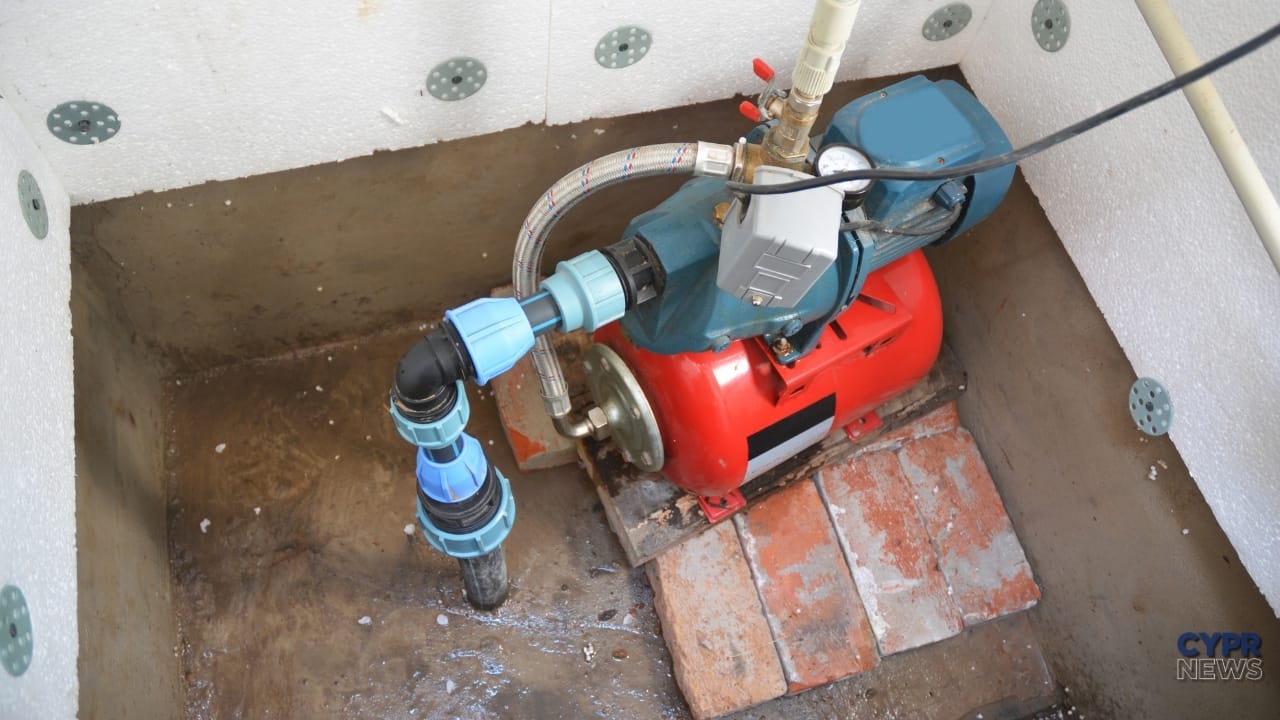
Cypriot authorities are unable to accurately determine how much water is extracted from the island's underground resources each year. Problems include incomplete records, a lack of systematic meter readings, and limited inspections. Meanwhile, in 2024, 137,548 licensed wells were registered.
The Cyprus Investigative Reporting Network's findings, based on data from the Department of Water Development and reports from the Auditor's Office, reveal a serious flaw in the system. The state can determine how much water some well owners can legally extract, but it doesn't know how much they actually pump.
Groundwater remains one of the most important sources of water for Cypriot agriculture. According to a review by the Auditor's Office, approximately 76 percent of water used for irrigation came primarily from private boreholes.
At the same time, the condition of underground resources is alarming. Of the 22 identified groundwater reservoirs, 14 are in poor condition.
Their condition is influenced by, among other things:
The problem is particularly serious near the coast. When freshwater levels drop too low, seawater can infiltrate the aquifer.
Reversing this process is difficult, time-consuming, and in some cases, may prove impossible. Simply limiting subsequent water intake is not always enough to quickly restore the saline reservoir to its previous quality.
In 2024, the Department of Water Development reported 137,548 licensed wells. Of these, 98,720 were licensed before 2010, when records were kept by individual district administrations.
Older records still exist, primarily in the form of paper documents and topographic maps. However, much information has not been entered into the central database.
As a result, officials do not have an immediate and complete picture of the number of wells operating in a given area, their locations, applicable limits or the history of inspections performed.
As of March 2026, the digital records included 46,353 water collection points with annual limits. Their owners could legally pump approximately 149.4 million cubic meters of water.
This doesn't mean, however, that this is the actual amount of water withdrawn. It is merely the sum of the amounts permitted in the issued permits.
The Department of Water Development does not know the actual consumption because it does not have complete information on how many boreholes are equipped with working meters.
Even if the device is installed, its readings are not always regularly read and transmitted to the central system. In practice, the office may know the permissible annual limit but not whether the owner is complying with it.
Incomplete data also make it difficult to assess the actual pressure on individual aquifers. Resources can be overexploited for many years before the effects become visible in the form of lower water levels, drying of adjacent wells, or deterioration of water quality.
Abstraction limits are not evenly distributed. Approximately 66% of the database's points can abstract no more than 500 cubic meters per year. However, these represent only 4.4% of the total permitted volume.
At the other end of the scale, there are 665 wells with the right to extract at least 30,000 cubic meters per year.
They only make up about 1.4% of all points on the digital list, but they account for almost 68% of all approved water volumes.
Auditors believe that with a limited number of employees, audits should focus primarily on the largest recipients and entities that previously exceeded established limits.
The scale of the problem is illustrated by the case of Monagroulli in Limassol District. Two companies using five licensed wells have been accused of extracting significantly more water than their permits allow since 2015.
Excessive extraction reduced the efficiency of neighboring wells, including those used to supply a nearby town.
According to auditors, at certain times one company could have pumped out as much as 26 times more water than the established limit.
Despite repeated violations, the company was initially fined €400 and later €2,000. Five years after the initial audit, violations, inadequate inspections, and wells operating without renewed permits were still detected.
The auditors also identified approximately €90,000 in fees that had not been charged.
The Department of Water Development points to long-standing staff shortages as one of the main reasons for the insufficient number of inspections.
Between 2023 and 2025, 54 additional staff were hired and procedural changes were initiated. However, simply increasing staff numbers won't solve the problem if documentation remains incomplete and meter readings aren't streamlined into a single system.
Among the proposed solutions is the installation of smart meters that would automatically transmit consumption data. This would allow for faster detection of exceedances and reduce the need for on-site inspections.
It's also crucial to set penalties so that excessive extraction becomes financially unprofitable. A fine of hundreds or even thousands of euros may not deter a company that derives significantly greater profits from illegally extracted water.
There is a bill in parliament that would review permits every 12 years, create a collection register and strengthen the control system.
A complete register should include information on the well location, owner, applicable limit, meter readings, inspection history and any violations.
The mere existence of a well and the issued permit does not allow for an assessment of the actual pressure on underground resources.
Until a system of regular meter readings and effective enforcement of limits is established, the state will still not know how much of one of the island's most valuable resources is actually disappearing from the ground.
Sources: Cyprus Investigative Reporting Network, Cyprus Mail, Audit Office of the Republic of Cyprus, Department of Water Development.