Supported by


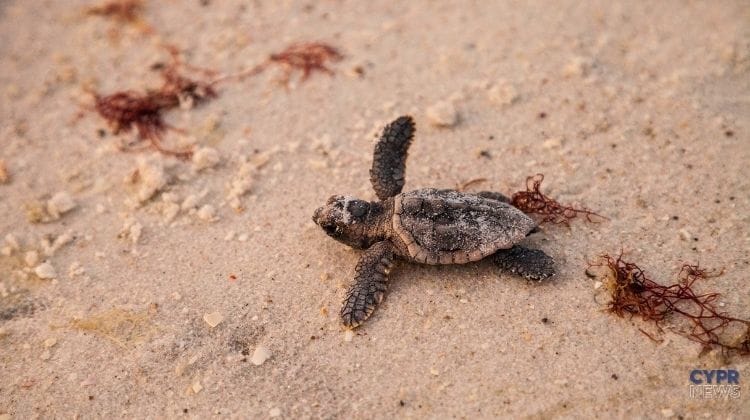
Sea turtles in Cyprus are currently experiencing one of the most important times of the year. In summer, females lay eggs on sandy beaches, and in August, some of the nests begin to produce young, making their first foray into the Mediterranean.
Two species nest on the island: the loggerhead (Caretta caretta) and the green turtle (Chelonia mydas). One of the most important areas for their conservation is Lara–Toxeftra on the Akamas Peninsula, but breeding sites are also found on other sections of the west coast.
Loggerhead and green turtles spend most of their lives at sea, but females return to sandy shores to lay their eggs. The eastern Mediterranean is particularly important for the green turtle, with the Cypriot Department of Environment citing Cyprus as one of the most important breeding areas for the turtle in the region.
Both species can be found in the Lara–Toxeftra region. There, sandy beaches alternate with rocky coastlines, and the entire area has been designated a protected area due to its importance for turtle breeding.
This doesn't mean, however, that turtles are found exclusively on Lara. Official monitoring programs also cover other parts of the west coast and Chrysochous Bay.
Visit Cyprus indicates the period from July to September as a time when you might be lucky enough to see newly hatched turtles in the Lara Bay area. However, this isn't a specific time of day – it all depends on the natural cycle of individual nests.
In the case of the green turtle, the Department of the Environment reports that each nest contains about 120 eggs. Incubation lasts about seven weeks, after which the young emerge from the sand.
Their first journey is very short but incredibly important. The young instinctively head towards the brightest part of the night horizon, which, in natural conditions, leads them towards the sea.
It's worth knowing
The female green turtle doesn't lay eggs every year. According to the Department of the Environment, she typically returns to breed every two to three years, and during a single season, she may lay around three to five nests, spaced about two weeks apart.
The history of turtle conservation here dates back decades. The first regular beach surveys began in 1976, two years later the Lara Turtle Station was established, and in 1989 the Lara–Toxeftra protected area was established.
Today, the Department of Fisheries and Marine Research monitors beaches and secures nests. The rule is to leave them exactly where they were placed. If a nest is too close to the sea and there's a risk of flooding, it can be moved higher, but on the same beach. According to UNEP/MAP, this applies to about 5% of nests.
The distinctive barriers visible in the sand are not random structures. They protect the areas under which the eggs develop and help limit human and predator interference.
In Lara–Toxeftra the period of special protection lasts from June 1 to the end of SeptemberDuring this time, restrictions apply to both beaches and parts of the adjacent sea.
From sunset to sunrise, people are not allowed on protected beaches. Setting up umbrellas and sunbeds, camping, and driving vehicles onto the beach are also prohibited. Regulations also restrict entry and anchoring of vessels, as well as most forms of fishing, in the protected part of the sea.
This is especially important in August. Wanting to see baby turtles doesn't mean you can wander between nests at night or try to help the animals yourself.
The best help is no interference.
Please do not move the fences, dig up the sand, or attempt to remove the young from the nest yourself. The conservation program is run by specialists, and the nesting beaches are monitored.
Also, encountering a young turtle heading to the sea should remain an observation of a natural phenomenon, and not an opportunity to touch or move the animal.
This is one of those cases where the best photo can be taken from a distance.
The green turtle was legally protected in Cyprus as early as 1971. Subsequent monitoring programmes, nest protection and the establishment of the Lara–Toxeftra reserve have meant that activities have been carried out here not for a few seasons, but for decades.
That's why footprints in the sand, a small metal nest protection, or a small turtle heading for the water are more than just a holiday curiosity.
This is the next stage in the life cycle of animals for which some of the Cypriot beaches remain one of the most important places in the entire Mediterranean.
The material was prepared based on information from the Department of Environment, Department of Forests, Department of Fisheries and Marine Research, Visit Cyprus and UNEP/MAP – Regional Activity Centre for Specially Protected Areas.