Supported by


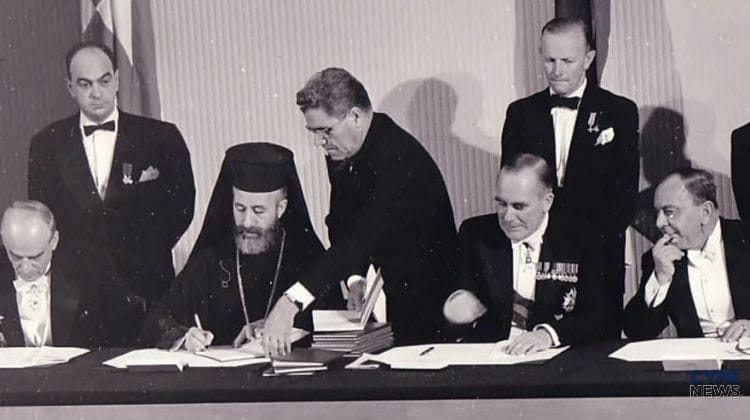
Today is exactly 66 years since Cyprus gained independenceOn August 16, 1960, the Republic of Cyprus was established, ending 82 years of British rule on the island. The new state was established on the basis of agreements previously concluded in Zurich and London.
Archbishop Makarios III became the first President of the Republic, with Fazıl Küçük, a representative of the Turkish Cypriot community, serving as Vice President. The political system of the new state was designed to ensure that neither community could independently dominate its institutions.
The foundation for the creation of the Republic of Cyprus was the Zurich-London Agreements, negotiated in 1959 by Great Britain, Greece, and Turkey, with the participation of representatives of both Cypriot communities. These agreements included a constitution and three key treaties: the Establishment of the Republic, the Guarantees, and the Alliance.
The agreement ended the period of British rule at a time when EOKA had been engaged in armed activity for several years. The organization, led by Georgios Grivas, fought against the British administration and sought enosis, i.e. the annexation of the island to Greece.
For the Turkish Cypriot community, the prospect of enosis was unacceptable. In response, the concept of Taxim, i.e. the division of the island.
The final compromise was therefore neither annexation to Greece nor partition, but the creation of an independent Republic of Cyprus.
The constitution of the new state precisely regulated the participation of both communities in governance. The president was to be a Greek Cypriot elected by the Greek Cypriots, and the vice president was to be a Turkish Cypriot elected by their community.
The Council of Ministers consisted of seven Greek Cypriots and three Turkish Cypriots. The system also provided for separate rules for electing some representatives and mechanisms designed to prevent one community from unilaterally changing the fundamental principles of the state's operation.
The president and vice president also received special powers, including the ability to veto certain decisions.
Independence did not mean Britain's complete withdrawal from the island.
Under the Treaty of Establishment, the United Kingdom retained sovereignty over the areas Akrotiri and Dhekelia, which still function today as British Sovereign Base Areas.
At the same time, the Treaty of Alliance established defense relations between Cyprus, Greece and Turkey, while the Treaty of Guarantee referred to the independence, territorial integrity and constitutional order of the new state.
The agreements excluded both the annexation of Cyprus to another state and the division of the island.
The process of transition from colonial administration to an independent state has been completed August 16, 1960.
On that day, the Republic of Cyprus formally began its existence as an independent and sovereign state. Official materials of the Republic of Cyprus indicate August 16 as the date of proclamation of independence.
The British flag was lowered and the symbols of the new state took its place.
There is one interesting fact here that often surprises people living on the island: Cyprus gained independence on August 16, but the official Independence Day is celebrated on October 1.
The formal anniversary of the founding of the Republic falls today, while the main state celebrations, including the traditional military parade, take place on October 1.
The decision to postpone the official celebrations was made several years after independence. One reason was to avoid holding the most important state ceremonies during the peak August summer and summer vacation period.
Today the Republic of Cyprus begins 67th year of its existence.
Source: Press and Information Office of the Republic of Cyprus