Supported by


Cypriot bananas are easy to miss on the store shelf. They're usually smaller than the larger, more uniform imported fruits, but their small size is one of their most distinctive features. They are grown primarily on the west coast in the Kissonerga and Peyia areas near Paphos.
Both types can be found side by side in Cypriot stores. And don't judge them solely by size—the most reliable indicator is the country of origin on the label. Imports are significant: in 2024, Cyprus imported approximately 10,500 tons of bananas, with Ecuador being the largest direct supplier.
This is a simplification, but there is a lot of truth in it.
The official gastronomic guide of the Paphos region clearly states that local bananas are distinguished by their smaller sizeThey are also known for their intense aroma and sweet taste.
The most important variety grown on the island is Dwarf CavendishThe Department of Agriculture also offers the Gelik variety, which is taller and matures later.
However, a large banana does not automatically mean a specific country, just as a small fruit is not 100% proof of Cypriot origin.
Therefore, in the store it is best to do the simplest thing: check the label.
This is what the bananas we found on the store shelf look like:
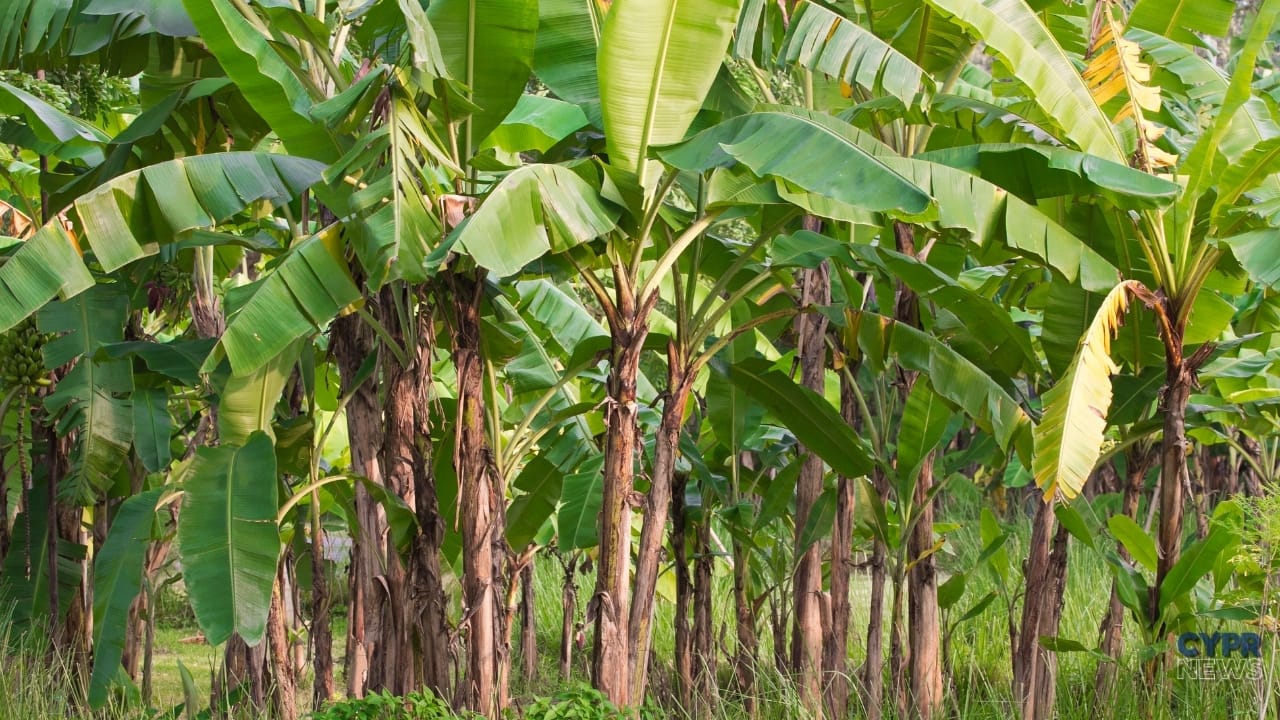
Plantations are most associated with the stretch of coast between Kissonerga and Peyia.
The Department of Agriculture reported the area under cultivation at approximately 260 hectares, with production intended primarily for the domestic market, and only small quantities are exported.
This is why, driving along the coastal road from Paphos towards Coral Bay and Peyia, you can see vast expanses of characteristic, intensely green plantations.
Local production is not enough to meet all demand.
Trade data for 2024 shows imports of approximately 10.49 million kilograms of bananas. From Ecuador alone, approximately 6.63 million kg, and significant amounts also reached Cyprus via Greece.
Also in the data for 2025, Ecuador remained one of the most important sources of supply.
That's why large bananas that we know from supermarkets in Poland or other European countries are also common here.
Cypriot ones constitute a local alternative to them.
Interestingly, local bananas also feature in the daily price monitoring conducted by the Cypriot Department of Agriculture.
On September 3, 2026, the average retail price of local bananas was €1.65 per kilogram. The price obtained by the producers' organization for green fruit was EUR 0.50/kg.
However, the department adds an important clarification: after harvesting, green bananas are prepared for sale and ripened in special chambers. The cost of this process is estimated at around €0.20 per kilogram.
This also shows that the popular image of a banana ripening to full yellow on a plantation does not always correspond to the commercial path the fruit takes to the store shelf.
There is one more interesting fact.
Although we are talking about "banana trees", botanically the banana tree is a perennial herbaceous plant.
What appears to be a trunk is actually a pseudo-trunk formed by the tightly packed sheaths of the enormous leaves. The Department of Agriculture also emphasizes that the banana tree's root system is relatively shallow.
The banana plantation looks a bit like a tropical orchard, although from a botanical point of view it is not actually an orchard.
The program promoting local products "Heartland of Legends" indicates that the main harvest period of Cypriot bananas begins in October and lasts until April.
This means that we are entering a period when local fruit will increasingly appear on the market.
Next time you see much smaller fruit next to large bananas in the store, don't immediately assume it's an inferior quality.
Look at the label. It's quite possible you're looking at bananas grown just a few kilometers from Paphos.
Sources: Department of Agriculture Republic of Cyprus, Visit Paphos, Heartland of Legends, UN Comtrade/World Integrated Trade Solution.,